1Intelligent Robotics, Sungkyunkwan University
2Mechanical Engineering, Sungkyunkwan University 3Production Engineering Research Institute, LG Electronics Int.
J. Precision Engineering and Manufacturing (IJPEM), 2026 *Indicates Equal Contribution
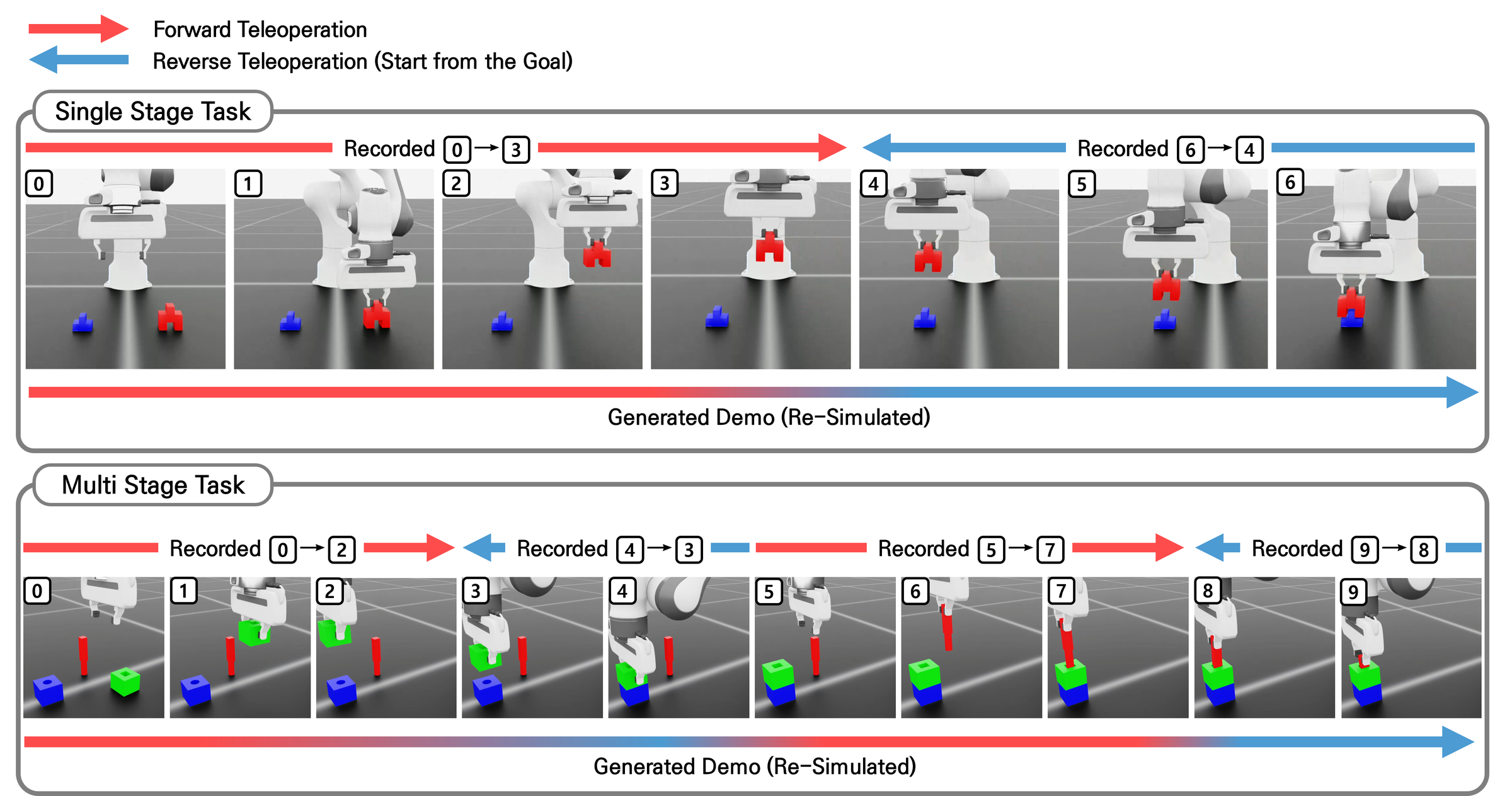
Hard sub-tasks are teleoperated backward from the goal state, easy ones forward.
Time-reversing and re-simulating the reverse segments yields a complete forward demonstration —
the operator never has to perform the difficult alignment motion.
Abstract
High-quality robot learning data is essential for advancing Vision-Language-Action (VLA) models, yet
collecting it at scale remains the primary bottleneck in their development. This bottleneck is further
amplified for manipulation tasks that require tight pose alignment or impose geometric constraints, where
small errors lead to task failure, such as peg-in-hole. To address this, we propose Reverse Playback
Motion (RPM), a novel data collection framework for robot manipulation. Rather than attempting to
precisely place an object into a target configuration, operators instead start from the goal state and
perform the reverse motion, which is inherently easier to execute. The collected reverse motions are then
reconstructed into valid forward trajectories through time-reversal of the recorded end-effector poses. We
evaluate RPM across five constrained manipulation tasks, including both single-stage and multi-stage
scenarios, and demonstrate that it enables up to 3 times faster data collection for non-expert
operators, while achieving superior policy performance compared to conventionally collected demonstrations.
Overview
Numbered frames are key states of each task. A task is split into sub-tasks, and each sub-task is
teleoperated in whichever direction is easier: red segments are recorded
forward, blue segments are recorded in reverse, starting from the
goal. The “Recorded a→b” labels give the order in which the operator actually
teleoperated each segment — note that it is not the order the robot will eventually execute.
The full demonstration is then obtained by playing the recorded segments back along the time-ordered
trajectory. Single-stage tasks (top) need one reverse-recorded segment; multi-stage tasks
(bottom) alternate several forward and reverse segments. Either way the operator skips every hard
alignment motion, and what comes out is an ordinary forward demonstration.
Why reverse?
Teleoperation difficulty is asymmetric. Inserting a peg into a hole demands millimeter-level
alignment; extracting the same peg starts from a feasible contact configuration and skips the
alignment phase entirely. Better still, the geometric boundaries that obstruct the forward motion act as
natural guides along the reverse path.
Naively replaying the recorded actions backwards does not work, because the dynamics are not
time-symmetric — gravity resists upward motion but assists downward motion, while friction always opposes
travel. Reversing the action stream also degrades execution to open loop, and residual errors accumulate
until the trajectory diverges.
RPM therefore treats the time-reversed end-effector pose sequence as a reference trajectory and
re-executes it in simulation, re-deriving the actions from the tracking error. Both the action
stream and the camera images are recorded anew, so every modality stays in sync with a physically valid
rollout; only successful regenerations are kept. Forward and reverse segments are then concatenated and
augmented at scale with MimicGen.
Up to 3× faster collection
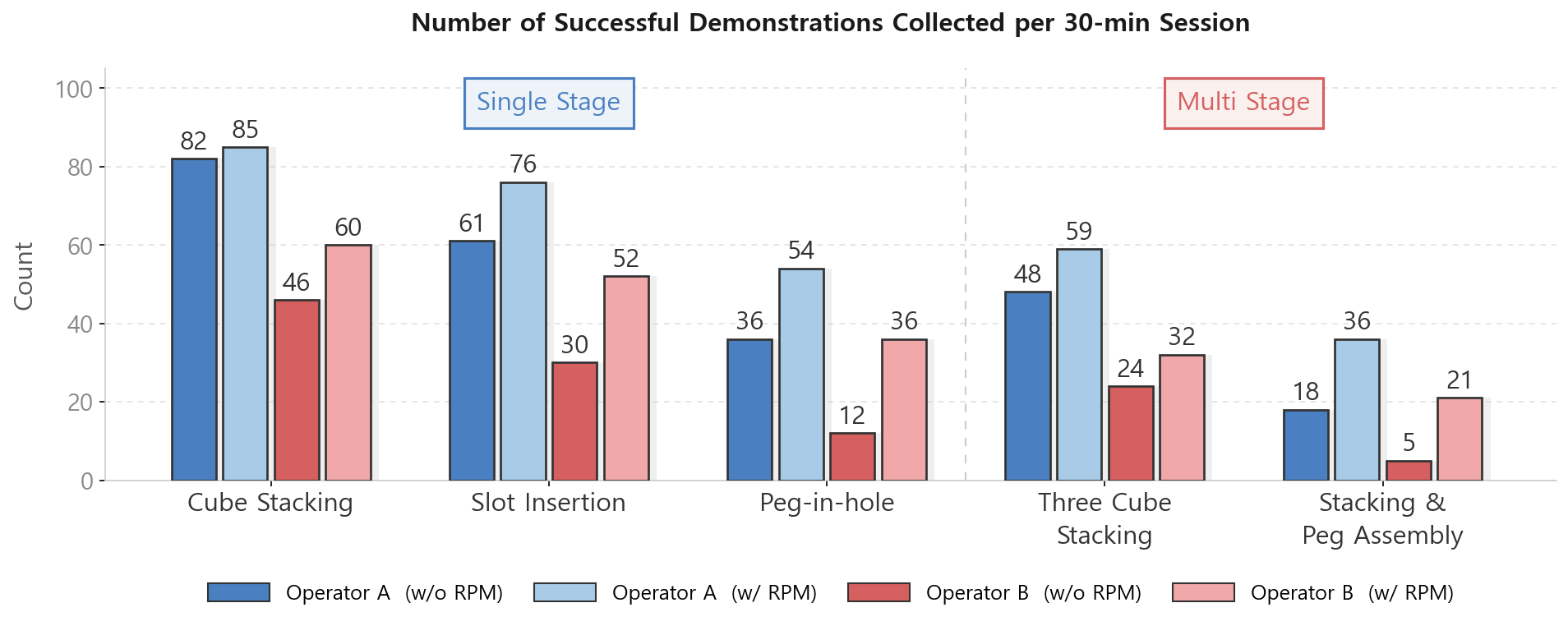
An expert (Operator A, 100+ hours) and a non-expert (Operator B, under one hour) each collected
data for 30 minutes per task. RPM helps both, but the gain is largest for the non-expert and for
longer-horizon tasks — exactly where conventional teleoperation is weakest. On Peg-in-Hole,
Operator B goes from 12 to 36 demonstrations (3×); on Stacking-and-Peg Assembly, from 5
to 21.
Better policies, same data quantity
We fine-tune GR00T N1.5 on the augmented datasets. The same number of seed demonstrations and the
same augmentation factor are used with and without RPM, so any difference reflects data quality,
not quantity. Success rates improve on every one of the five tasks.
Single stage
Multi stage
Without RPMWith RPM
Without RPMWith RPM
Cube Stacking
Without RPMWith RPM
Slot-Insertion
Without RPMWith RPM
Peg-in-Hole
Without RPMWith RPM
Three-Cube Stacking
Without RPMWith RPM
Stacking-and-Peg Assembly
Single-stage (success rate)
Cube Stacking
Slot-Insertion
Peg-in-Hole
Relative task pose
32%
60%
36%
Relative task pose + RPM
60%
70%
50%
Absolute joint angle
78%
96%
56%
Absolute joint angle + RPM
96%
98%
74%
Multi-stage (success rate, with Temporal Ensemble)
Three-Cube Stacking
Stacking-and-Peg Assembly
Absolute joint angle
76%
6%
Absolute joint angle + RPM
86%
32%
The advantage grows with task horizon.
Where the gain comes from
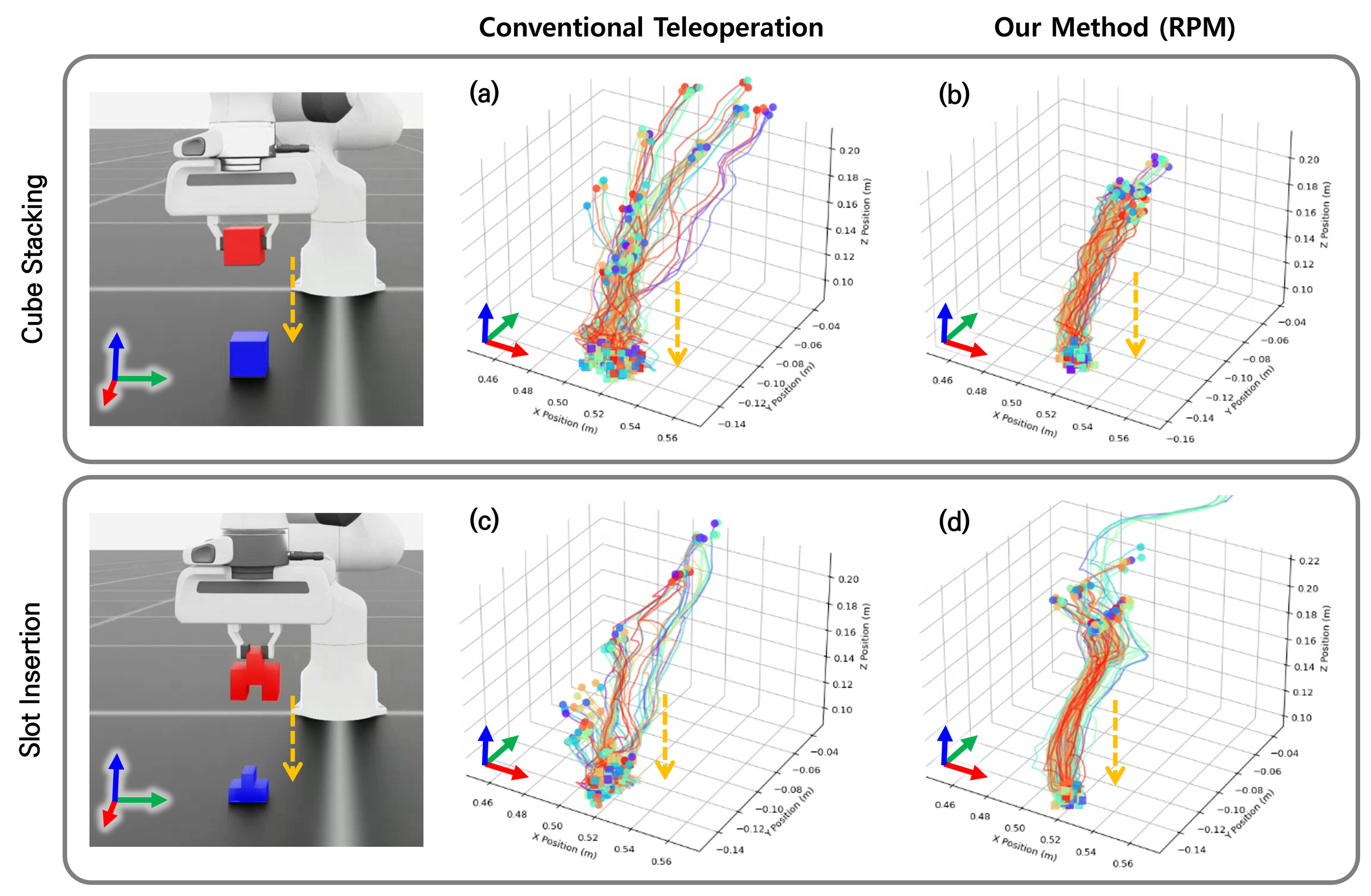
Conventional teleoperation oscillates and collides during the final approach — variability that
destabilizes the learned policy. Recording from the goal state suppresses that noise: trajectory standard
deviation drops from 3.74 to 2.66 (−28.8%) for stacking and 4.04 to 2.77 (−31.5%)
for insertion.
BibTeX
@article{kim2026reverse,
  title={Reverse Playback Motion: A Simple Way for Anyone to Obtain High-Quality Demonstration Data},
  author={Kim, Hyunjun and Won, Jaeseog and Jung, Hong-ryul and Kim, Donghoon and Ko, Minsuk and Moon, Hyungpil},
  journal={International Journal of Precision Engineering and Manufacturing},
  pages={1--11},
  year={2026},
  publisher={Springer}
}